With two cars to design and build, the Formula SAE student team is firing on all cylinders.
If building one race car sounds tough, try building two. That’s the mission of Formula SAE at Virginia Tech, an undergraduate engineering design team formed in 1988 that designs, manufactures, and races not one, but two small, formula-style race cars.
And they’re keeping the pedal to the metal to stay ahead of the competition. In 1991, Formula SAE at Virginia Tech placed first in competition and established itself as a top-tier team. Since then, the team has accumulated eight top-10 finishes and six top-five finishes.
What is Formula SAE?
Formula SAE is an international competition based in the U.S. that challenges university students to design, manufacture, and race small, open-wheel cars. The cars are built entirely from scratch, from chassis to suspension, and students are responsible for developing either an internal combustion engine or an electric powertrain. Ambitiously, Virginia Tech’s Formula SAE team does both. The process takes around eight months from start to finish and requires extensive planning and coordination between team members to produce the double final product.
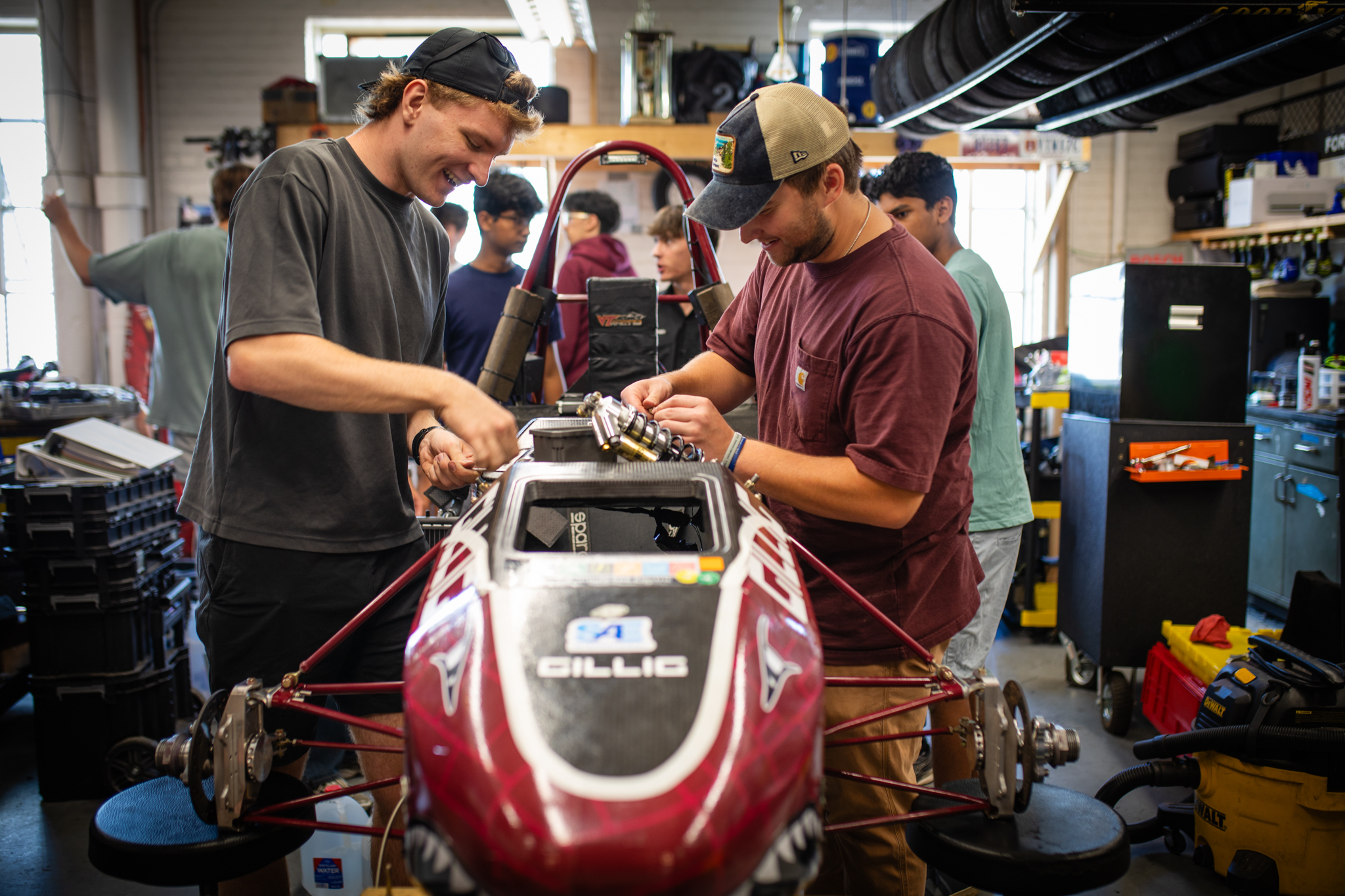


Luckily, the team is large. Made up of 70 students, it consists mostly of mechanical engineers, although there are also students from materials science and engineering, industrial systems engineering, packaging, and electrical engineering, in addition to an active business team with finance and business majors. They’re based in the Ware Lab, but they also have labs at the Virginia Tech Corporate Research Center and the Virginia Tech Transportation Institute.
One team, two cars
Max Mueller and Harrison Bruhl serve as the team leads for the internal combustion vehicle and the electric vehicle, respectively. “It is undoubtedly a huge challenge both financially and workload-wise,” explained Mueller. But the team has found ways to keep both on schedule. “We are developing a new electric powertrain and have a strong electronics subteam that is working on this second vehicle’s development without interfering with the internal combustion vehicle.”
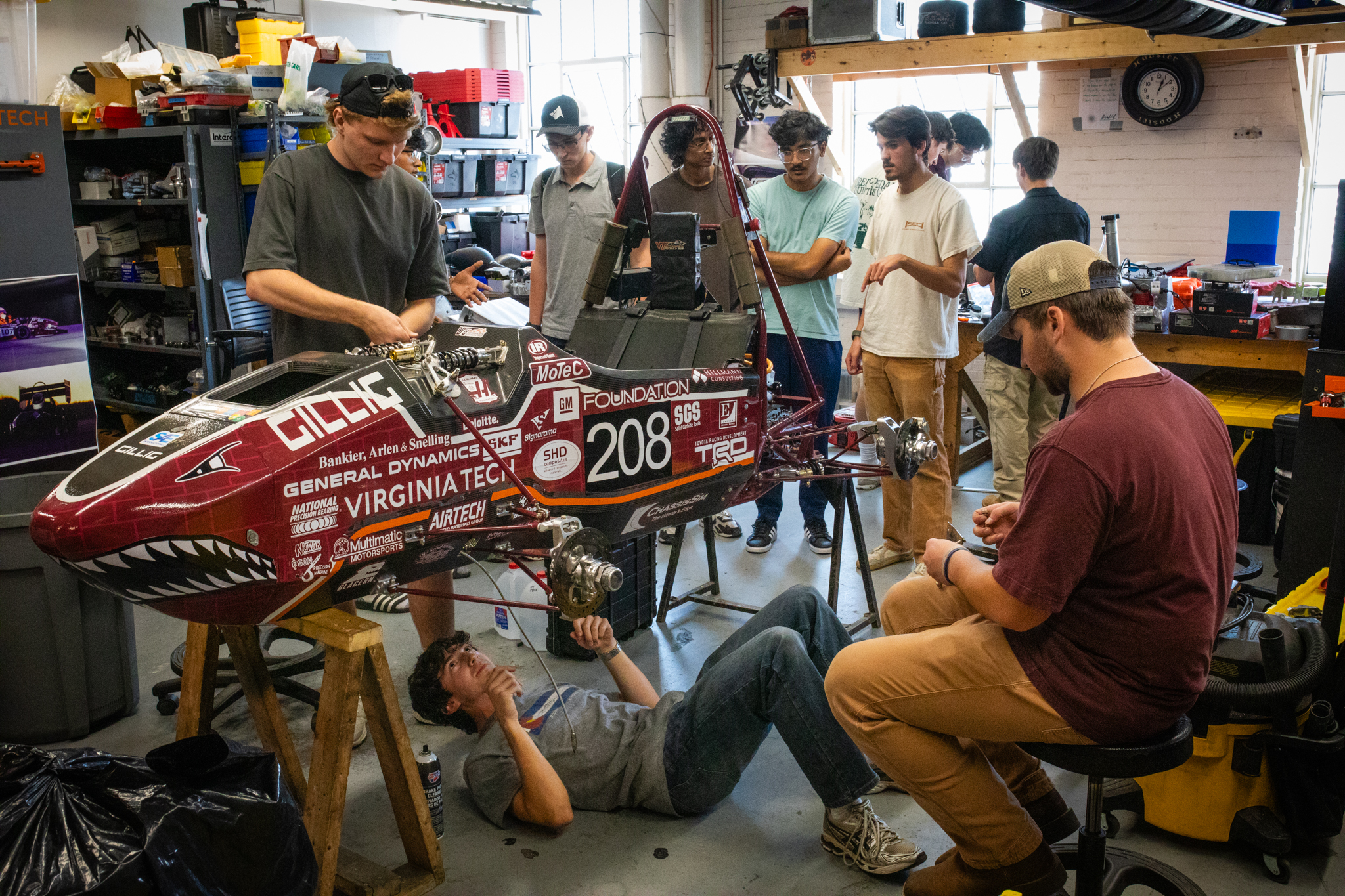


The team is broken into four subteams: aerodynamics, suspension, powertrain, and chassis. Individual team members are usually tasked with designing, manufacturing, and testing a single component — hubs, shifting, brakes, and so on. Subsystem projects require significant expertise in mechanical design, data analysis, sensor physics, thermodynamics, aerodynamics, material science, vehicle dynamics, internal combustion and electric powertrains, and many more fields across engineering. Team and subteam leads handle scheduling and management.


How the competition works
At competitions, judges award points for both on-track performance and off-track events. Students on the team are the ones to race their cars in various events, including a drag race that gauges acceleration, an agility course, and a race of multiple laps that tests the car’s speed and fuel efficiency. Successful cars are minimally light, maximally powerful, have significant downforce from aerodynamic elements, and have all subsystems tested and tuned for peak performance while maintaining reliability.
In off-track events, teams explain their vehicle design to a panel of judges. They also share their business plan and their success building most of the vehicle in house with funding from sponsors.


What’s next for the team?
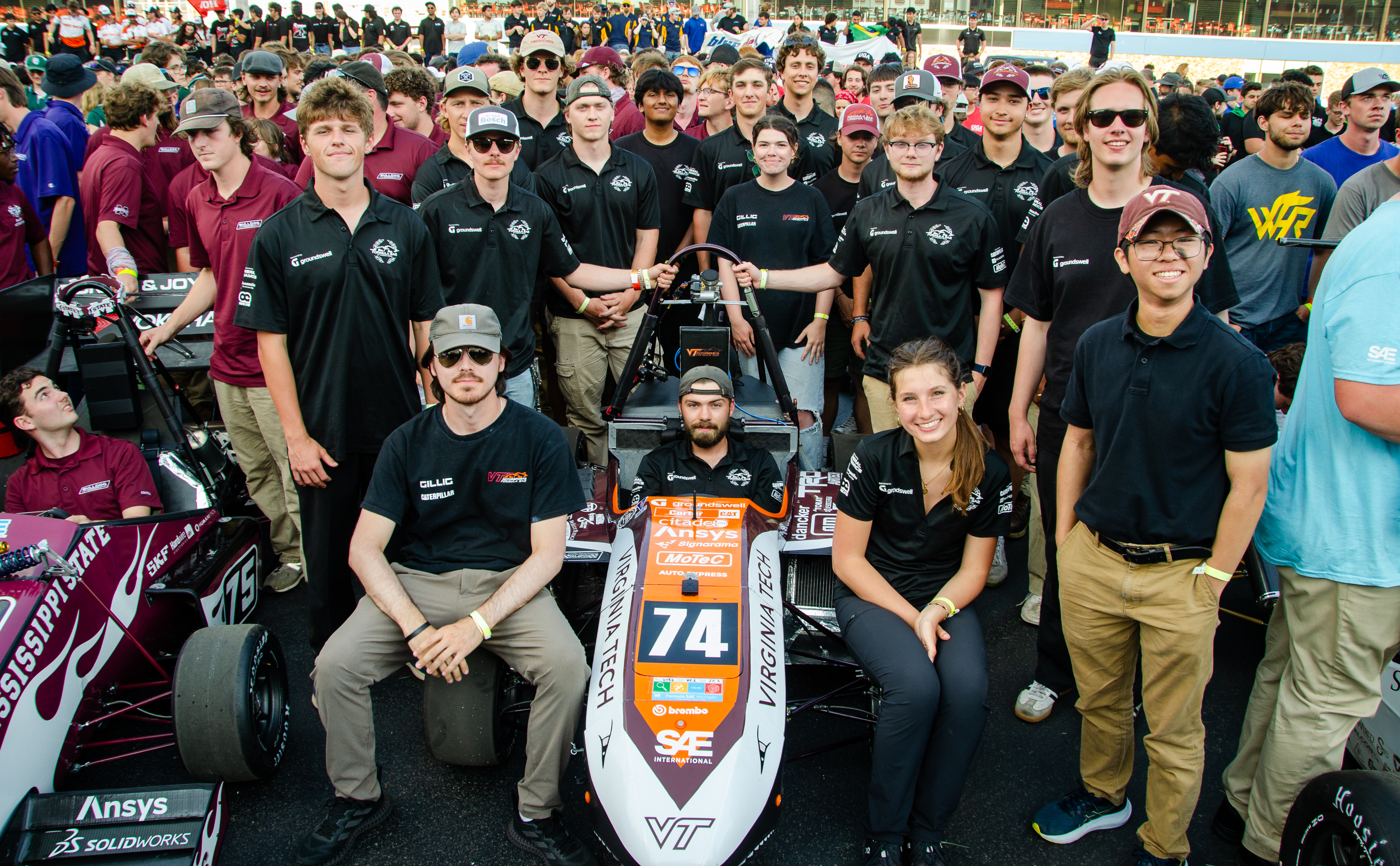
Virginia Tech’s Formula SAE team is currently preparing its two vehicles for competition at Michigan International Speedway in 2026. They will race their internal combustion vehicle in May and their electric vehicle in June. “I am extremely excited for this upcoming year for many reasons,” said Mueller. “We are coming off a 15th place overall performance out of 120 teams, with the fastest autocross time from a non-aero team. We were design finalist runners-up and scored highly in static events.”
Since then, the team has made beneficial changes to suspension geometry and intake and exhaust design that should make the car lighter, more powerful, and easier to drive. “We are also adding an aero package that promises competitive downforce numbers,” Mueller explained. “All of this should combine to a very successful finish in 2026.”
Meet the team leads

Max Mueller
IC Project Lead

Harrison Bruhl
EV Project Lead

Daniel Catlett
Business Lead
Entrepreneurship Innovation Technology Management, ’27
"My favorite part of being on Formula SAE at Virginia Tech is being able to represent the importance of business in a field full of engineers."

Cameron Boynton
Powertrain Lead
Mechanical Engineering, ’26
“My favorite part is all the research and validation needed to prove that a design improves the car. Also seeing how industry experts apply the knowledge they gain with the team is always cool.”

Dillon Lewallen
EV Powertrain Lead
Mechanical Engineering, ’27
“My favorite part of working on Formula SAE at Virginia Tech is being able to apply the concepts we learn in class and put them into practice.”

Corbin Jensen
Aerodynamics Lead
Mechanical Engineering, ’27
“My favorite part about working on the team is the friendships and connections you can build here, along with the passion we all share for the project.”

Abdul Hussein
Suspension Lead

Alex Lombardo
Independent Study Lead
If you want to have an impact on our students and faculty like those featured in this magazine, go here to support the College of Engineering. For more information, call (540) 231-3628.
-
Article Item
-
Article Item
-
Article Item